


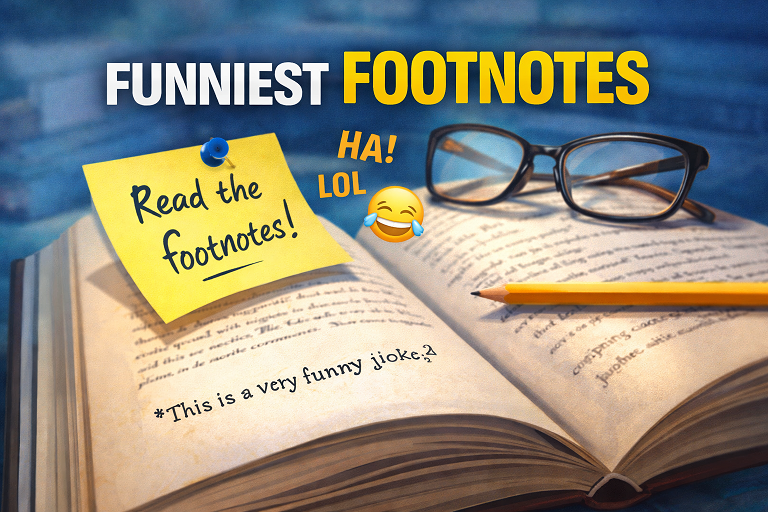
Footnotes are usually meant to clarify, cite sources, or provide additional information—but sometimes, they do something far better: they make readers laugh. The keyword funniest footnotes captures a delightful niche of writing where authors use the bottom of the page to sneak in humor, sarcasm, and unexpected commentary.
What Are Footnotes?
Footnotes are notes placed at the bottom of a page that provide extra details without interrupting the main text. They are commonly used in:
- Academic writing
- Historical books
- Research papers
- Literary works
But in the hands of creative writers, footnotes can become comedic gold.
Why Funny Footnotes Work So Well
1. Surprise Factor
Readers expect footnotes to be serious and informative. When they encounter humor instead, it creates a delightful surprise.
2. Breaking the Fourth Wall
Funny footnotes often allow authors to speak directly to the reader, adding personality and wit.
3. Hidden Humor
Because they’re optional, footnotes feel like a “bonus joke” for attentive readers.
Famous Examples of Funniest Footnotes
1. Sarcastic Clarifications
Some authors use footnotes to mock their own writing or add ironic commentary.
Example:
“This theory is widely accepted¹”
¹By me.
2. Overly Detailed Explanations
Turning a simple point into an unnecessarily long and funny explanation.
3. Random Tangents
Footnotes that go completely off-topic, creating absurd or hilarious mini-stories.
Authors Known for Humorous Footnotes
Certain writers have mastered the art of funny footnotes:
- Terry Pratchett – Known for witty, unexpected notes in fantasy novels
- David Foster Wallace – Famous for long, complex, and often funny footnotes
- Douglas Adams – Used humor in every possible way, including footnotes
Their work shows that even the smallest part of a page can leave a big impression.
Types of Funny Footnotes
1. Meta Humor
Jokes about the writing itself or the author’s thought process.
2. Dark Humor
Unexpectedly serious or dark jokes delivered casually.
3. Absurd Humor
Completely ridiculous and illogical comments that catch readers off guard.
4. Self-Deprecating Humor
Authors making fun of themselves in a lighthearted way.
How to Write Your Own Funny Footnotes
If you want to create your own funniest footnotes, try these tips:
- Keep it short and punchy
- Use contrast with the main text
- Don’t overuse them—less is more
- Add personality and voice
A well-placed footnote can elevate your writing and entertain your audience.
Why Readers Love Funniest Footnotes
Funny footnotes reward curiosity. Readers who take the time to look down the page are often rewarded with clever jokes or hidden gems. This creates a stronger connection between the writer and the reader.
Conclusion
The keyword funniest footnotes highlights a unique form of humor that lives quietly at the bottom of the page. Whether subtle, sarcastic, or completely absurd, these footnotes prove that even the smallest details in writing can have the biggest impact. Next time you see a tiny number in a sentence—don’t ignore it. It might just be the funniest part.
Read More on Casa Blanca