


OpenCV (Open Source Computer Vision Library) is one of the most powerful and widely used tools for computer vision and image processing. Originally developed by Intel, it has grown into a massive open-source project maintained by a global community of developers. Today, OpenCV supports multiple programming languages including Python, C++, and Java, and is used in everything from simple image filters to advanced AI systems.
What is OpenCV?
OpenCV is a library designed to help computers “see” and understand visual data such as images and videos. It provides hundreds of optimized algorithms for tasks like:
- Image filtering and transformation
- Object detection and recognition
- Face detection
- Motion tracking
- Feature extraction
Because it is open-source and highly optimized, it is widely used in both academic research and industry applications.
Key Features of OpenCV
1. Real-Time Processing
OpenCV is built for speed. It can process images and videos in real time, making it ideal for applications like surveillance systems and self-driving cars.
2. Cross-Platform Support
It works on multiple operating systems including Windows, Linux, macOS, Android, and iOS.
3. Multiple Language Support
You can use OpenCV with:
- Python (most popular for beginners)
- C++ (for performance-heavy applications)
- Java
4. Huge Collection of Algorithms
Open Source Computer Vision Library includes pre-built functions for:
- Edge detection (e.g., Canny)
- Image smoothing
- Morphological operations
- Machine learning models
Common Applications of Open Source Computer Vision Library
Face Detection
OpenCV can detect human faces using pre-trained models like Haar cascades. This is widely used in security systems and social media filters.
Object Recognition
Used in identifying objects in images or videos—important in robotics and automation.
Medical Imaging
Helps analyze X-rays, MRIs, and other medical scans.
Autonomous Vehicles
Self-driving systems rely heavily on computer vision to detect lanes, obstacles, and traffic signs.
Augmented Reality (AR)
Open Source Computer Vision Library enables overlaying digital objects onto real-world environments.
Basic Example (Python)
Here’s a simple example of reading and displaying an image:
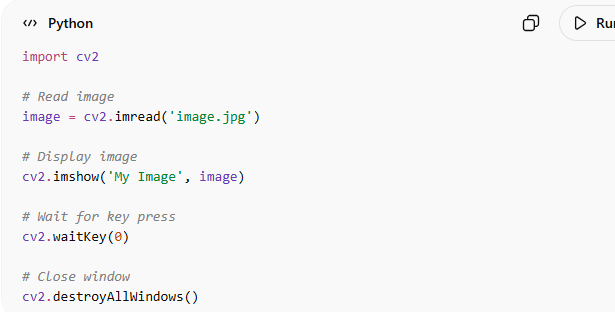
This small program loads an image and displays it in a window.
Advantages of OpenCV
- Free and open-source
- Highly optimized for performance
- Large community support
- Extensive documentation
- Easy integration with AI frameworks like TensorFlow and PyTorch
Limitations of Open Source Computer Vision Library
- Steep learning curve for beginners
- Some advanced tasks require additional AI libraries
- Not always the best for deep learning (needs integration with other tools)
Why Learn Open Source Computer Vision Library?
Learning Open Source Computer Vision Library opens doors to modern technologies like:
- Artificial Intelligence
- Robotics
- Automation
- Smart surveillance
- Image and video analytics
With the growing demand for AI and computer vision, Open Source Computer Vision Library is a valuable skill for developers, engineers, and researchers.
Conclusion
OpenCV is a powerful and versatile library that plays a crucial role in the field of computer vision. Whether you’re building a simple image filter or a complex AI-powered system, Open Source Computer Vision Library provides the tools you need to get started and scale your projects.